
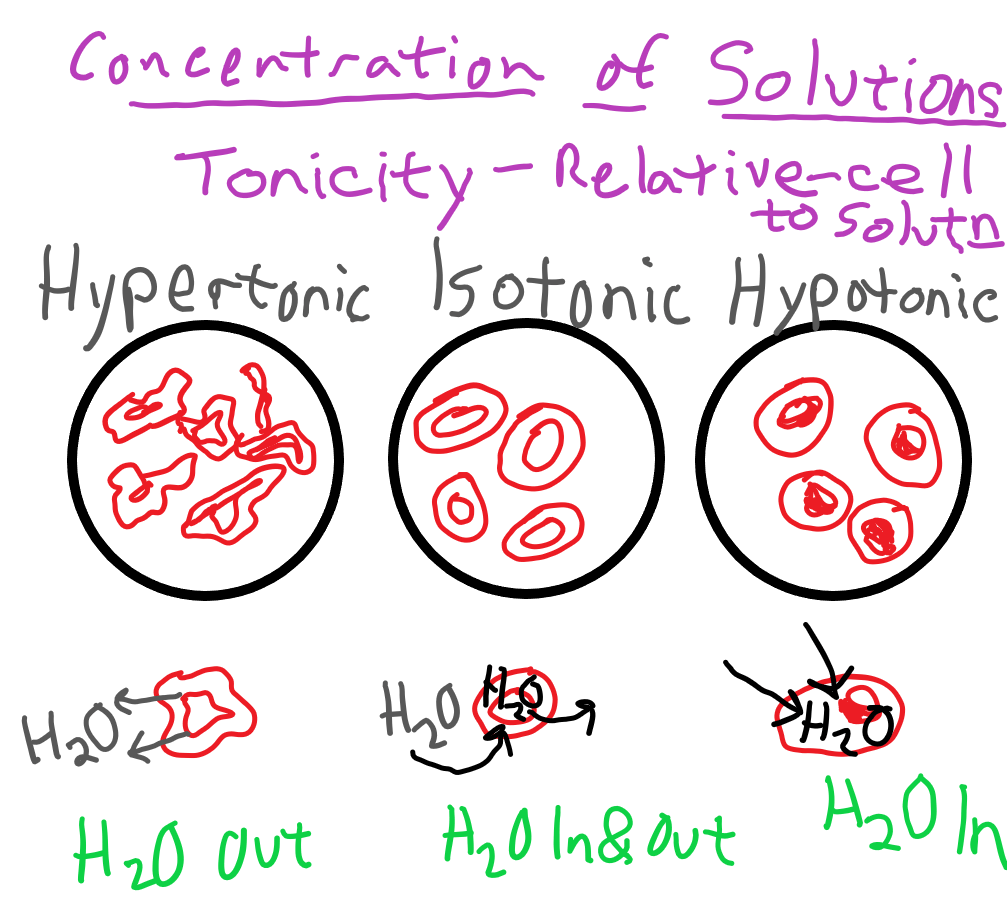
This second discussion of an important topic in Anatomy and Physiology will cover concentration of solutions – in other words, does the cell shrink or burst, or neither, when placed in different solutions? Tonicity is the concept governing the answer to this commonly asked question. The first thing to realize here is that we only consider the movement of water in and out of the cells. There are small solute particles that may pass in and out. They are insignificant when figuring tonicity. Tonicity refers to the amount of solute particles dissolved in a solution relative to the amount dissolved on the inside of the cell or cells in question. Red blood cells are often used as an example because it’s important for them to be healthy, and not shrinking or bursting. Those are RBCs in my drawing, which would be something similar to what I would draw on the whiteboard, were I to be giving a lecture on this topic. I’m writing now something similar to what I would say, if I were to lecture on this topic. I call these discussions and drawn figures “Lecture Notes on Anatomy and Physiology.” Continuing with tonicity, placing a RBC in a hypertonic solution would cause water to leave the RBC and begin to shrivel. If the solution in hypertonic enough, the cell dies. Equal amounts of water flow in and out when the RBC is placed in an isotonic solution. The prefix iso- means equal. Remember the old isosceles triangle. Finally, a RBC in a hypotonic solution will swell and possibly burst. Water gets sucked into the cell by osmosis, as the solutions even out the concentrations inside and outside the RBC. Again, the small solutes passing in and out of the RBC are insignificant here, when determining whether the cells will shrink or swell. This is why one does not give water in an IV line, but saline solution instead. An influx of water into our blood would dilute the surrounding plasma outside the cells, causing water to rush into the RBCs. This would likely damage the cells, and maybe even cause many to burst. Probably not a good thing to happen in our blood, right? I hope this helps you with this important Anatomy and Physiology topic.
Concentration of Solutions and Tonicity
 RandomProfessor