Cell Membrane Phospholipid Bilayer
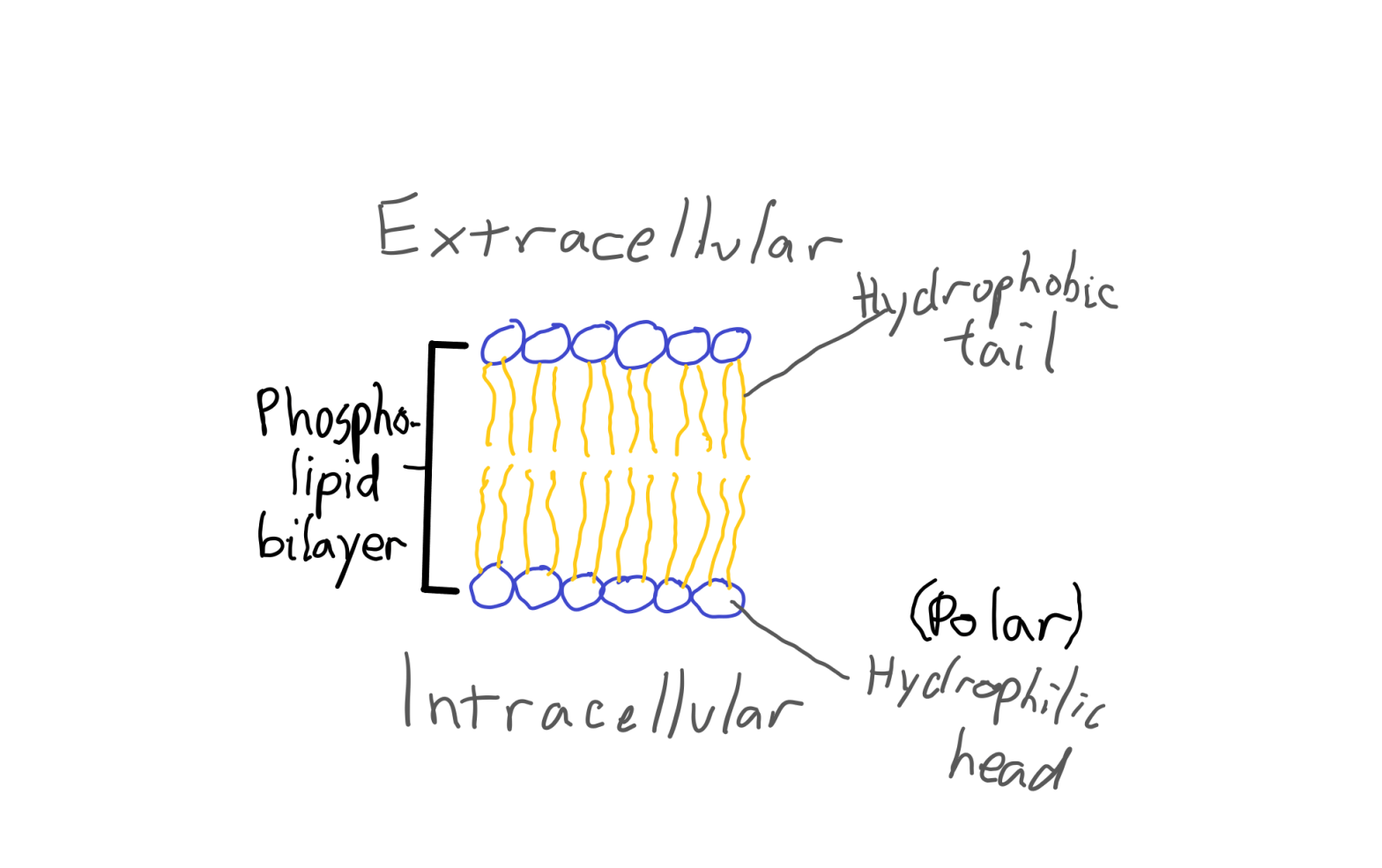
In Anatomy & Physiology, a commonly tested, yet often poorly understood topic is the cell membrane. I am going to discuss the basics of the cell membrane, focusing on what crosses the membrane. The name phospholipid bilayer describes exactly the basic structure of the cell membrane. By understanding this, one can easily figure out whether or not a particular molecule will cross the bilayer. It is two layers (bilayer) of phospholipids. These phospholipids are arranged such that like touches like, and unlike does not touch unlike. Yes, very similar to the saying, “like dissolves like…” and the same chemical principles govern the two concepts. The polar heads (phospho-) align next to water which is polar also. The lipid tails try to escape the water because they are nonpolar, or oily. This is also referred to as water-hating, or hydrophobic. Please use my attached diagram as you read this Lecture Note on this topic. This membrane, which is of course the cell, or plasma, membrane floats in water along with whatever solutes are present in the water. As far as what will pass through the membrane, consider that this membrane mainly consists of lipid, or hydrophobic, nonpolar tails. Thus, nonpolar molecules will pass easily (like dissolves like & like passes through like) through the plasma membrane. These molecules must also be small enough to pass, since the membrane filters out larger molecules. Remember, keeping intracellular and extracellular spaces separate is essential for the health of any cell. Polar or charged molecules do not pass through this membrane without some sort of help, like a protein pore traversing the membrane. Na+ and K+ ions pass through such pores. Even though these ions are small, they are charged, making them unable to pass the largely nonpolar (like non-charged, but not exactly) phospholipid bilayer. In summary, charged and polar molecules do not pass the membrane without some help, such as active transport or facilitated diffusion. Nonpolar, hydrophobic molecules pass easily through the membrane, as long as they are small enough. I want to keep this to a simple, conceptual discussion, and I will refer you to your books and your internet for detailed tables covering specifically which molecules cross. I want this to serve as a good basis for figuring out whether or not something will cross the membrane in cases where your memorization attempts fail. Always keep in mind that memorization is not a good strategy for learning anatomy and physiology. Having a solid understanding of the basics of a concept will serve any student much better.









 RandomProfessor